Crowyrs are winged mammals capable of sustained lengthy flights. They are crepuscular animals, those which are more active at dawn and dusk. After initial encounters with the quick-to-strike species, Isomara discovered that crowyrs are very social and friendly creatures.
- Crowyr Masterlist [WIP]
- Crowyr Species Visual Trait Index
- Crowyr Design Guide [WIP]
- Unveiling the Aerial Attacker - Crowyr Discovery Event
Anatomy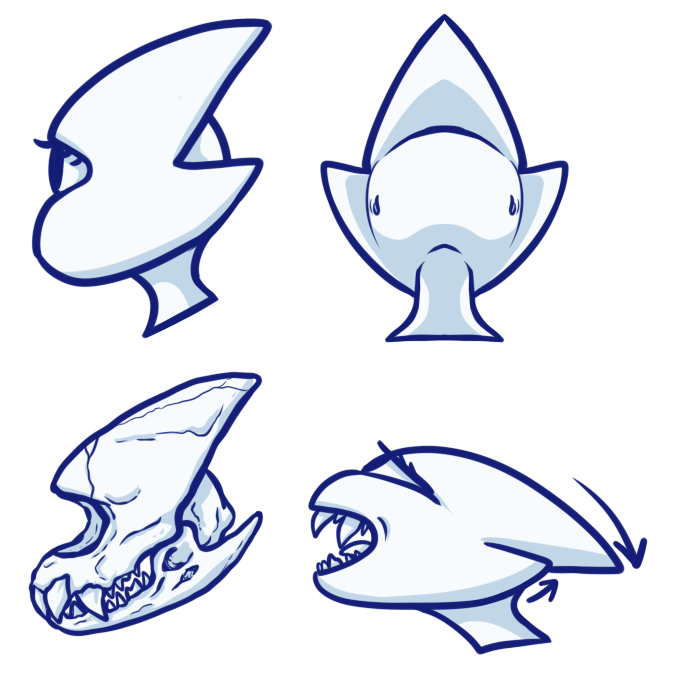
Crowyrs have teardrop shaped heads with a single large eye socket and sharp pointed teeth. The pointed part of their cranium is referred to as their coronet. The shape of the coronet not only protects the brain it also aides in the aerodynamics while in flight by reducing drag.
On the side of their heads under the coronet and behind their jaw protrusion are their ear canals. They have poor frontal hearing but excellent rear hearig.
This creature has no nose instead takes in oxygen directly through their mouth. This likely explains why crowyrs are often seen with mouths agap while flying. Inside of their mouths are miniscule sensors which assist in "smelling" and detecting different chemicals in the air.
Size
Taller than a blepper, Crowyrs can reach up to two feet (61 cm) tall. Their wing span is two-three times their height.
Life Expectancy
The average Crowyr lifespan is estimated up to 25 years. Although most Crowyrs of lower rank do not make it past 18 years. Many of the higher ranked Crowyrs in the colonies have to deal with far fewer threats than those who must go out to hunt, forage, and scout.
Colonies & Hierarchy
Based on observations, Crowyrs seem to have their own organized structure to their colonies. Preferring a larger group to avoid any potential predators. Multiple colonies have been encountered across the vast sea outside the isomara's island. Every colony seems to be ruled by an empress and/or emperor. Crowyrs are assumed to be a matriarchal society, as an overwhelming majority of the colonies observed were ruled by an empress. From the many investigations into their colonies we have discovered these roles in their hierarchy:
- Empress / Emperor
- The ruler of the colony, typically an empress. An emperor is only the sole leader if his empress is deceased. It seems the emperor is not allowed to take a new empress, and a new one will only be chosen if he steps down from his role, leaves the colony, is fought for the role, or passes away. Most Empresses seem to sport the Ruff trait while Emporers have the Lapel trait.
- Dukes
- The leaders of the colony who only take orders from the empress and emperor. There can be many dukes in a colony. Dukes are promoted to their role by the empress/emperor. It seems that one duke usually manages a group of 4-8 crowyr. They command when and who should be leaving the colony and when to return. Oftentimes the dukes will accompany their group of crowyrs to oversee their work.
- Guards
- Lookouts for the colony and groups among them. These crowyrs leave the colony only as watchful eyes overseeing other crowyrs on their daily duties. Guards do not have to find their own food and will always be given first picks from the food pile after the empress and emperor. Many crowyrs will often provide guards with bribes of succulent insects to ensure their safety and provide favor in the colony. There are roughly twice as many guards as there are dukes in a colony, and there are always two guards each protecting the emperor and empress (four guards total if a colony has both an empress and emperor). Frequently seen traits among guards are Talon feet and Needles.
- Caregivers
- Assigned crowyrs who take care of crowyr pups when their parents are out of the colony. These crowyrs are often older or younger crowyrs who do not fall within the prime age to fulfill the daily job duties. These crowyrs are still given lots of respect in the colony, as they are often teachers to the next generation.
- Hunters / Fishers / Collectors
- The majority of the crowyrs in a colony fulfill one of these three roles. How to tell which one is which is by what time of day they leave their colony to perform their duty.
- Hunter crowyr work primarily at night, forcing themselves to commit to an almost nocturnal lifestyle. They hunt with their claws to bring back food for the colony. Hunters will primarily search for small slumbering critters and insects.
- Fisher crowyrs work mostly in the mornings before the sun warms the sea and the fish retreat to colder waters. Using their claws and teeth, they swoop down and capture small fish and other creatures that reside near the surface of the water, like water snakes and unsuspecting small birds. Fisher crowyrs have been seen to dive as far as 6 ft deep but are always seen to propel themselves back up as soon as possible. It appears they are quite averse to the waters. Note: It seems crowyrs with Remex wings are ineligible to be fishers
- Collectors are the remaining crowyrs who hunt for fruits and insects. The crowyrs will leave their nests at the crack of dawn and remain out and about until dusk. They will often take a short nap during midday before continuing their foraging before heading back home. The majority of crowyrs are collectors. There was no commonly shared trait among the collector crowyr, so it seems a crowyr with any kind of traits can be a collector.
- Vagrants
- These are outsiders who typically are not a part of a colony. They roost by themselves, find their own food even if accompanied by another. Rarely are vagrants coupled together, but even when they have a partner, they are not seen to share responsibilities.
Intelligence & Behavior
Quite intelligent with a major memory flaw. Crowyrs have been studied to be intelligent, but due to their limited long term memory, most new instructions and teachings are often fleeting. They can be taught to use tools; however, while you can give one, for example, a shovel, the crowyr will not know what or how to use it. If you initiate a specific action with the tool, they will learn to mimic you and the action. This mimicry makes them extremely useful to bring in explorations and voyages.
These flying mammals, while having poor long-term memory, are still able to navigate the vast seas and recall sources of food and their previous roosting locations. They make for great companions and will follow orders with little to no rebuke. They don't play well with Memora.
Diet
Crowyrs have been noticed to eat nearly anything. Most have been seen to be either primarily insectivores or herbivores. Many fall between these categories and will eat anything from moths, beetles, spiders, and other insects to various fruits found across the seas. Not only that, a couple of isomara have clearly stated to have seen a crowyr consuming a lizard and frog, respectively. Not a single crowyr has been accounted to have attempted to hunt or eat an isomara of any age, and when it comes to other larger creatures, they tend to ignore them as a source of food. Perhaps sizing them up quickly as not a good use of energy.
Mating & Life Cycle
Crowyrs give birth to a single pup at a time and will only be able to have two pups a year. The pup will be ready to take care of itself after only three months. For the first few months though it will remain in the colony and be kept under close supervision by its parents and caregiver crowyrs. The mothers are allotted a week to bond with their pup, but must return to their duties where then after the caregivers step in.
After one month the crowyr pup is expected to know how to fly and two months after will be delegated a role in the colony of either a hunter, fisher, or collector. These juvenile crowyrs will be accompanied by one to two other crowyrs for the next six months whenever they leave the colony. After a year and a half the Crowyr is no longer a juvenile and is seen as an adult where it will be able to perform its duties fully without supervision, but their work will be scrutinized for the reminder of their life or time in the current colony. Dukes and Guards will eye over young adult crowyrs and treat them harshly to ensure they bring in plenty for the colony to survive and thrive.
During adulthood the Crowyr will be allowed to find a mate of similar or lower rank in the colony. Crowyrs can also reach out to other colonies, but one of the crowyrs must permanetly move to the other Colony. A Crowyr may only move colonies once in its life and usually this is only for mating. Throughout a Crowyrs life they will likely have multiple mates within a single colony.
Relation with Isomara
While crowyrs have never been seen to bite an isomara, outside of Follow-Up Report #3, they have frequently attacked them. During the initial hunt for the Crowyrs, Isomara were purposlely seeking out and trailing these creatures which put them on high alert. All the colonies were in a tizzy about these large winged creatures hunting rightfully so. Thus is caused many an attack. Why the initial attack is unknown perhaps there was an underlying related cause?
Since then though effort has been made to become amicable partners. Thyme and other isomara have helped create a new colony of Crowyrs on the island and have brought even more vagrants here to become companions. The species seems very friendly and easy to cohabit with.
Companion Perks
As companions crowyrs bring a lot to the table and seem to be the first companion species who can keep up with isomara on a voyage, but that is not the only activity they are useful in.
Exploration
- +1 Roll to fruits when exploring forest and jungle
- Can even find fruits that only gatherer class isomara could find/harvest
- Increased chance of memic encounters when exploring
Training
- +1sp to the crowyr's companioned isomara when included in the training
Voyaging
- +1 roll to all items not found in the ocean
Companion Skills
Sincere Flattery
- Crowyrs with skill will be able to use the same tools their isomara companion also own and will receive bonus rolls with those tools
- Both the Crowyr and Isomara must each have the same tool(s) in order for the skill to activate
- All equipment attached to a crowyr has a +5% chance to break
Scouter
- Your crowyr will continue the voyage while their isomara companion heads home. The crowyr has a chance to bring back item(s) from an adjacent direction.
- Crowyr have a +10% chance to return with an ailment
Crowyr F.A.Q
Q. What is the history of the Crowyr species?
A. The species was created and previously owned by Auremun. Crowyrs were created in March 2017 by Auremun with assistance by Numerua when it came to details and traits about the species. SlayersStronghold first discovered the species in April 2017 and adopted two crowyrs and created one more. After a little more than a year the species fell quiet, but not forgotten. In June 2025, Slayer reached out to Auremun and began a conversation about purchasing the rights to the species. Soon after the rights were now in Slayer's hands and work began on how to integrate the new species into the world smoothly. In September 2026 the event which led to the introduction of Crowyrs into Isomara Island occurred.